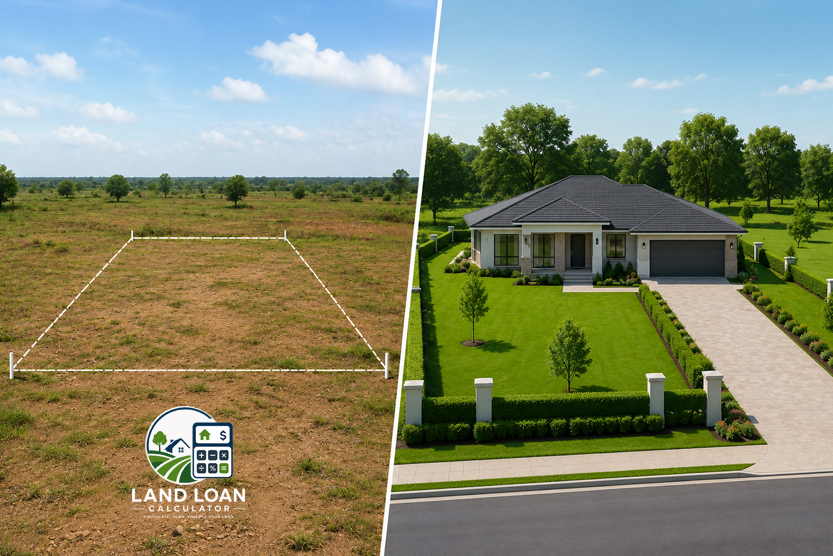
Standing in front of a piece of property you like, the last thing on your mind is probably loan classification. But it’s the first thing your lender cares about. Understanding raw land vs improved land loan differences changes almost everything about the deal – the rate, the down payment, even whether some lenders will touch it at all.
The short version: raw land means nothing’s been done to it. Improved land means it’s basically ready to build on. That’s the core of the raw land vs improved land loan question, and the distinction alone can swing your interest rate by two or three points. Your required down payment can shift by tens of thousands of dollars too. Worth understanding before you make an offer, not after.
What Actually Separates Raw Land From Improved Land (And Why Your Loan Depends On It)
Raw land is exactly what it sounds like. No utilities, no road access beyond maybe a dirt path, no grading – nothing. It’s land in its natural state. Some buyers love this precisely because it’s a blank slate, and the price per acre tends to be lower to match.
Improved land has the infrastructure already in place. Water, electricity, sewer or septic, a real road leading to it – someone’s already done the boring but expensive groundwork. You pay more upfront, but you also remove a huge chunk of risk and future cost.
There’s a middle category too, usually called unimproved or partially improved land. Maybe electricity runs nearby but nobody’s connected it yet. Maybe there’s road access but no utilities. Lenders price this somewhere between the two extremes, which makes sense once you see how they think about risk.
Why Lenders Care So Much About This
A lender’s whole calculation comes down to one question: if you stop paying, how easily can we get our money back? Improved land is straightforward to resell. Someone else can walk in and start building immediately. Raw land is a harder sell. Whoever buys it at foreclosure still has to run utilities, get permits, and maybe deal with zoning headaches before it’s usable for anything.
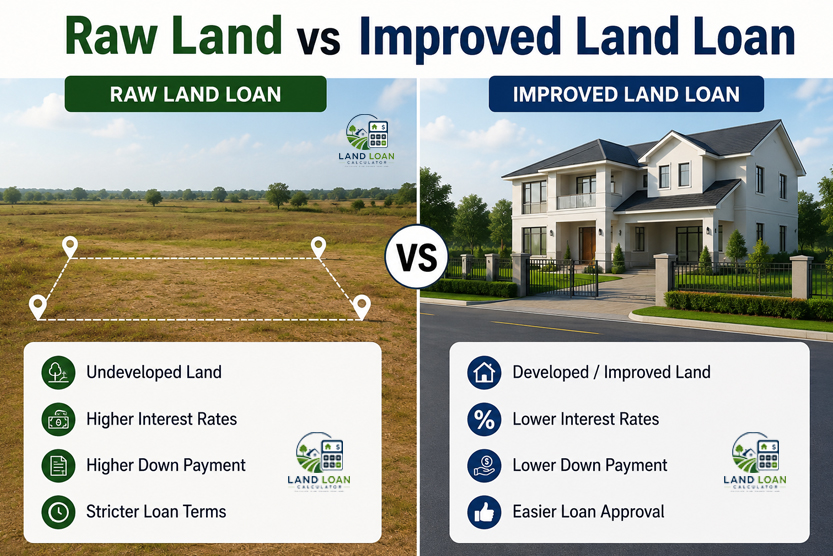
That gap in resale difficulty is exactly why raw land loans carry higher rates and demand more money down. It’s not that lenders don’t like land – they just price for how long it might sit unsellable if things go sideways.
Raw Land vs Improved Land Loan: Rates and Down Payments Side by Side
| Raw Land | Improved Land | |
|---|---|---|
| Typical interest rate | 9% – 12% | 7% – 9% |
| Typical down payment | 30% – 50% | 15% – 25% |
| Typical loan term | 5 – 15 years | 10 – 20 years |
| Lender availability | Fewer lenders, often local banks | Wider pool, including some national lenders |
| Appraisal complexity | Higher – depends on comps, zoning potential | Lower – closer to standard real estate appraisal |
These numbers shift depending on your credit and the specific lender. But the pattern holds pretty consistently across the market. The gap between the two categories is usually two to three points on rate, and at least 10-15 percentage points on down payment.
When Raw Land Actually Makes Sense
Raw land isn’t automatically the worse choice. It depends entirely on what you’re trying to do or tends to make sense if you’re buying for long-term appreciation and don’t plan to build anytime soon – you’re not paying for infrastructure you won’t use for years. It also fits if you found land significantly under market value specifically because it’s undeveloped, and you’re comfortable handling permits, utility hookups, and grading yourself down the line.
Farmers and ranchers often prefer raw or partially improved land too, since agricultural use doesn’t always require the same infrastructure a residential build would. Programs through the USDA Farm Service Agency sometimes offer more favorable terms for raw agricultural land than a conventional lender would.
When Improved Land Is Worth the Premium
Improved land is usually the better call if you’re planning to build within the next year or two. Paying for infrastructure now instead of financing it separately later often works out cheaper overall. It also makes sense if you want simpler financing – more lenders compete for improved-land loans, which can mean better rates even after accounting for the higher purchase price. And if you’re not interested in managing contractors, permits, or utility companies yourself, improved land removes most of that burden upfront.
A Real Numbers Comparison
Say you’re choosing between two parcels: 10 acres of raw land at $80,000, or a similar 10 acres already improved at $120,000.
On the raw land, at 10% interest with 40% down ($32,000), you’d finance $48,000 over 10 years – landing around $634 a month. Add in the cost of running utilities and grading later. Conservatively $25,000-$40,000, depending on distance from existing infrastructure. Your real total cost climbs well past what the sticker price suggested.
On the improved land, at 8% interest with 20% down ($24,000), you’d finance $96,000 over 15 years – around $917 a month. Higher monthly payment, but no surprise infrastructure bills waiting down the road.
Run both scenarios through a land loan calculator before deciding – the “cheaper” option on paper isn’t always cheaper once you add in what raw land costs to actually make usable.
Common Mistakes Buyers Make
People underestimate infrastructure costs on raw land more often than almost anything else in this process. Running utilities half a mile can easily cost more than the land itself in remote areas. Others assume all lenders treat land the same way — really, some banks won’t touch raw land at all, while others specialize in exactly that. Skipping a proper land survey before financing is another common one. Boundary disputes and easement issues surface constantly on undeveloped parcels, and they’re much cheaper to catch before closing than after.
Frequently Asked Questions
Can I convert a raw land loan into an improved land loan later?
Not directly, but once you’ve added infrastructure, you can often refinance into better terms since the property’s risk profile has genuinely changed. Learn more about how land loan refinancing works once you’ve improved your land.
Is unimproved land the same as raw land?
Not quite. Unimproved land usually has at least partial access to utilities or roads nearby, even if not fully connected. Raw land typically has none of that yet.
Do USDA loans cover raw land purchases?
Some USDA and Farm Service Agency programs do cover raw or agricultural land, often with more favorable terms than conventional lenders offer, particularly for working farms and ranches.
Bottom Line on Raw Land vs Improved Land Loan Decisions
Raw land and improved land aren’t just different price points – they’re genuinely different financial products with different rates, down payments, and lender pools. Raw land rewards patience and a willingness to handle development yourself. Improved land costs more upfront but removes most of that uncertainty. Which one fits depends on your timeline and how much hands-on work you’re willing to take on. Either way, run your specific numbers through a calculator before committing, since the sticker price rarely tells the whole story.