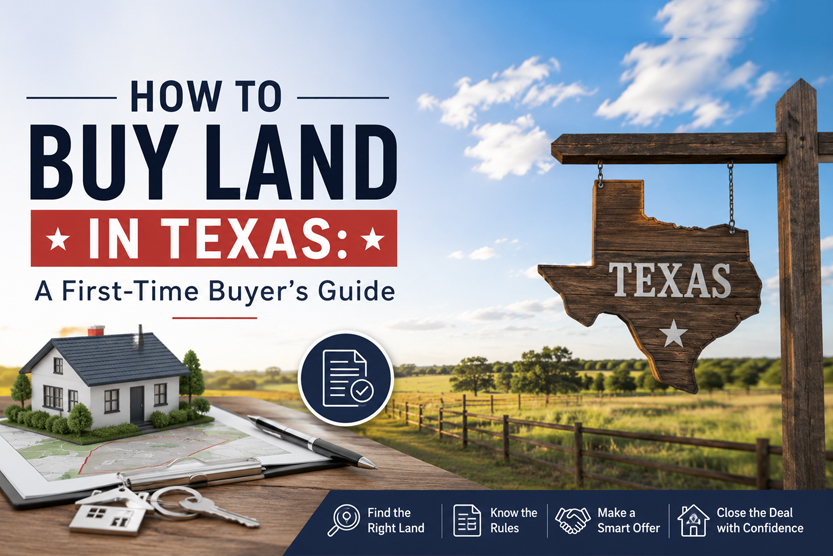
Quick answer: To buy land in Texas, first decide how you’ll use it (home site, ranch, recreation, or investment), then set a full budget that includes the loan, closing costs, and carrying costs. Search listings and local agents, check zoning and water rights for the specific tract, get a survey and title search done, secure a land loan, and close through a title company. Rural land outside city limits usually has no zoning, but it still comes with rules on water rights, access, and easements that most first-time buyers miss.
Texas has more private land for sale than almost any other state, and that’s exactly why the process trips people up. Prices swing wildly by county, financing rules aren’t the same as a home mortgage, and a “great deal” can turn into a landlocked lot with no legal road access. This guide walks through the full process, in order, so you don’t skip a step that costs you later.
Step 1: Decide Why You’re Buying the Land
Your reason for buying drives every decision after this one — location, size, price range, and even which loan you qualify for.
Ask yourself a few questions before you look at a single listing:
- Do you want to build a home now, or hold the land and build later?
- Are you after a working ranch, a hunting lease, or a quiet weekend property?
- Is this a straight investment, where you plan to resell or lease it out?
- How long do you plan to hold the property?
A buyer who wants a residential lot near a growing suburb has very different needs than someone chasing raw ranch land in West Texas. Write your goal down. You’ll refer back to it constantly once you start comparing properties.
Step 2: Set a Realistic Budget
Land in Texas is priced by the acre, and that price changes enormously depending on where you look. A rough regional snapshot:
| Region | Typical Price per Acre |
|---|---|
| Dallas–Fort Worth area | Up to $15,000+ (pasture land) |
| Houston exurbs (Montgomery, Grimes County) | $8,000–$20,000 |
| Panhandle and South Plains | Around $1,800–$2,500 |
| West Texas / Far West Texas | Often under $1,000 |
| Hill Country and Gulf Coast waterfront | Highest premiums in the state |
Prices shift year to year, so treat this as a starting point, not a quote. Check our breakdown of the average price per acre for land in Texas for current regional numbers before you shop.
Your budget needs to cover more than the purchase price:
- Down payment — usually 20–35% for land, much higher than a home mortgage
- Closing costs — typically 2–5% of the purchase price
- Survey and title work
- Site prep and utility hookups, if you plan to build
- 6–12 months of carrying costs — property tax, insurance, loan payments — while the land sits unused
First-time buyers almost always underestimate that last item. Budget for the land sitting empty for a year before it earns you anything back.
Step 3: Learn How Land Loans Actually Work
This is where buying land differs most from buying a house, and it’s the step people research the least before they start shopping.
Banks treat land as riskier collateral than a home, so terms look different:
- Down payments run 20% to 35%, depending on whether the land is raw, unimproved, or already has utilities and road access.
- Loan terms are shorter — often 5, 10, or 15 years, instead of the standard 30-year mortgage.
- Interest rates sit a bit higher than home loan rates. Check current land loan interest rates before you make an offer, since that number changes your real monthly payment.
A few financing paths are worth knowing before you talk to a lender:
- Farm Credit and community banks — the most common route for raw and rural land, and often more flexible than a national bank.
- Texas Veterans Land Board (VLB) loans — available to eligible Texas veterans, financing tracts up to $150,000 with as little as 5% down.
- USDA Rural Development loans — can offer low or no down payment in eligible rural areas, mainly aimed at buyers who plan to build a primary home. Our USDA zero-down land and construction guide covers eligibility.
- Owner financing — the seller finances the sale directly, which can mean a faster close and a lower down payment, but usually a higher interest rate.
Before you get a pre-approval, run your numbers through a Texas land loan calculator so you know roughly what you can afford. It takes two minutes and saves you from falling for a property outside your real budget. If you’re comparing lenders, our list of land lenders in Texas is a good place to start, and ranch or hunting-property buyers should also look at ranch and recreational land loan options, since they’re underwritten differently than a residential building lot.
Step 4: Search for Land the Smart Way
Once your budget and financing plan are in place, start looking.
- Listing sites like Realtor.com, LandWatch, and Lands of Texas cover most publicly marketed tracts.
- A land-specialist agent — not a general residential agent — knows which counties have water and easement issues, which properties come with an agricultural exemption, and which listings are about to hit the market. This one relationship often matters more than any website.
- County tax auctions and estate sales can offer below-market pricing, but properties usually sell as-is, with little chance to inspect beforehand. Treat these as advanced-buyer territory.
- Off-market deals — driving the area, talking to locals, and looking for “for sale by owner” signs still works in many rural Texas counties, especially in tight-knit communities where land rarely gets listed publicly.
If you haven’t picked a county yet, our guide to the best Texas counties to buy land in 2026 breaks down growth areas, tax rates, and land availability by region.
Step 5: Understand the Texas Rules Most First-Time Buyers Miss
This is the step that separates a smooth purchase from an expensive surprise.
Zoning
Land outside a city’s limits usually has no zoning in Texas. That sounds like freedom, and mostly it is — you can typically use rural land for residential, agricultural, or light commercial purposes without a zoning fight. But it also means your neighbor could put up something you don’t love, since the same lack of rules applies to them. Check for a deed-restricted subdivision, since those private restrictions can be stricter than any zoning code.
Water Rights
Texas splits water into two separate legal categories, and buyers who skip this step often regret it:
- Surface water — rivers, creeks, and lakes — belongs to the state. Pumping from a creek on your own land for anything beyond limited household use requires a state permit.
- Groundwater — the water under your dirt — generally belongs to the landowner under Texas’s “rule of capture.” You can pump it, but most counties now sit inside a Groundwater Conservation District (GCD), which can regulate well spacing and production limits.
Before you close, find out which GCD (if any) covers the tract, and confirm there’s a legal path to water — either a working well, a municipal connection, or a documented right to drill one.
Access and Easements
A landlocked parcel with no legal road access is far harder to finance, build on, or resell. Confirm the property has a recorded easement or public road frontage before you get attached to it. This single detail kills more first-time land deals than almost anything else.
Agricultural Exemption
Many rural Texas properties qualify for an agricultural or wildlife tax exemption, which can cut your property tax bill significantly. It usually requires the land to be actively used for farming, ranching, or wildlife management, and the qualifying use has to be established over time — it doesn’t happen automatically the day you buy.
Step 6: Inspect the Land Before You Commit
A land inspection looks nothing like a home inspection, and there’s no house to walk through, which makes it tempting to skip. Don’t.
Walk the property — or have your agent do it with you — and check:
- Topography — flood zones, drainage, and whether the terrain fits your plans
- Soil quality — especially for anyone planning to farm, build a septic system, or dig a foundation
- Existing fencing, structures, or improvements
- Utility access — electric, water, and how far the nearest connection point sits
- Environmental issues — old dump sites, contamination, or protected species habitat
- Neighboring land use — an active feedlot or industrial operation next door changes everything
Step 7: Get a Survey and Clear Title
Before you sign anything final, order a current land survey and a title search.
A survey confirms the exact boundaries, acreage, and any encroachments — a fence line that’s a few feet off can turn into a legal dispute years later. Title work confirms the seller actually owns what they’re selling, free of liens, unpaid taxes, or ownership disputes. Most Texas land deals close through a title company, and a real estate attorney is well worth the fee for a first purchase, even though it’s not legally required.
Step 8: Close the Deal
Closing on land follows a similar shape to closing on a house: final loan approval, a signed purchase agreement, closing disclosures, and the wire transfer, all handled through a title company.
Expect closing costs of roughly 2–5% of the purchase price, covering the survey, title insurance, recording fees, and lender charges. Once everything’s signed and recorded with the county, the land is legally yours.
Common Mistakes First-Time Land Buyers Make in Texas
- Buying land without confirming legal road access
- Skipping the survey to save a few hundred dollars
- Assuming “no zoning” means no rules at all
- Underestimating the down payment a land loan actually requires
- Forgetting property tax and insurance costs while the land sits undeveloped
- Not checking which Groundwater Conservation District governs the tract
FAQ: Buying Land in Texas
How do I buy land in Texas as a first-time buyer? Start by defining what the land is for, set a full budget including closing and carrying costs, get pre-qualified for a land loan, search listings or work with a land agent, then inspect, survey, and close through a title company.
How much down payment do I need to purchase land in Texas? Most lenders ask for 20% to 35% down, depending on whether the land is raw, unimproved, or already has road access and utilities. Veterans may qualify for as little as 5% down through a VLB loan.
Can I buy land in Texas with no money down? It’s uncommon, but USDA Rural Development loans and some VLB programs can offer very low or no down payment for eligible buyers and eligible rural tracts, usually tied to building a primary residence.
Do I need a real estate agent to buy land? It’s not required, but a land specialist — not a general home-sale agent — is worth having. They understand water rights, easements, and rural pricing in a way most residential agents don’t.
What’s the biggest mistake first-time land buyers make in Texas? Skipping the legal access and water-rights check. A parcel with no recorded road access or no clear path to water is far harder to finance, build on, or resell later.
Final Thoughts
Buying land in Texas rewards patience more than speed. Take the time to define your goal, get your financing lined up before you fall in love with a property, and never skip the survey or the water-rights check. Run your numbers through our free land loan calculator before you make an offer, so you walk into negotiations knowing exactly what you can afford.