Table of Contents
ToggleUSDA Zero-Down Loan Eligibility Calculator
Check whether your income, location, and property type fit the basic requirements for a USDA zero-down rural loan.
Preliminary result
—
This is a preliminary, educational check only — not an official USDA determination. Final eligibility depends on a full application, credit review, debt-to-income ratio, and USDA's current property and income maps. Confirm your address and income limit directly with a USDA-approved lender.
USDA Zero-Down Loan Eligibility Calculator
Before you spend weeks searching for property, use this USDA loan eligibility calculator first. It gives you a fast, preliminary answer to one question: does your situation fit what USDA requires? Enter your household income, your local limit, where the property sits, and how you’ll use it, and you’ll see exactly which requirements you clear.
What This Calculator Checks
A USDA Section 502 Guaranteed Loan lets qualifying buyers finance a home with zero down payment. However, that only works if they clear three core requirements, and this calculator checks all three at once:
- Income limit. Your household income must fall at or below your county’s USDA limit, counting every adult in the home. For 2026, standard limits run around $112,450 to $122,800 for a 1–4 person household in most counties.
- Property location. The home has to sit inside a USDA-designated eligible rural or suburban area. Despite the name, this covers far more than farmland — many small towns near major metro areas qualify too.
- Primary residence only. USDA loans finance the home you’ll actually live in. As a result, investment properties, vacation homes, and undeveloped land don’t qualify.
How to Use the Calculator
Start by entering your total household income, counting every adult in the home, along with your household size. Then look up your local income limit on the USDA eligibility site and enter that too.
After that, select your property’s location type and how you plan to use it, and click “Check eligibility.” You’ll get a pass or fail read on each requirement, plus an overall preliminary result.
What the Calculator Doesn’t Cover
This tool checks the three eligibility factors above, but a full application looks at more than that. A lender will also review your credit score, typically wanting 640 or higher for automated underwriting, though scores between 620 and 639 can still work through manual review. They’ll check your debt-to-income ratio, confirm your citizenship or residency status, and verify the exact property address, since eligible boundaries are sometimes drawn block by block.
If You’re Close But Not Under the Limit
Coming in slightly over the limit doesn’t automatically rule you out. USDA allows deductions before comparing your income against the cap, including a per-dependent deduction and childcare costs. A USDA-approved lender can run your adjusted household income and check whether those deductions bring you back under.
Financing Land or Construction With USDA
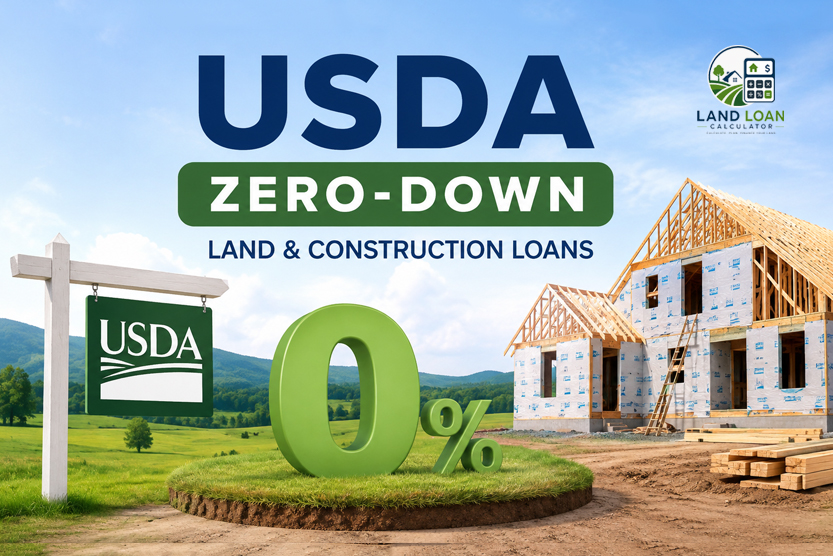
If you’re planning to build instead of buy, USDA also offers zero-down construction-to-permanent financing in eligible rural areas. Our guide on USDA zero-down land and construction loans covers how that program works and what property types qualify.
If USDA isn’t the right fit, our land loan calculator shows what a traditional loan’s payments look like instead. And if you’re sizing up a specific parcel first, our residual land value calculator and current average land prices per acre are useful next steps.
Frequently Asked Questions
What income counts toward the limit? USDA counts income from everyone 18 or older in the home, including wages, self-employment income, and pensions, not just the applicant’s pay.
Does 97% of the U.S. really qualify? Yes, mostly. Eligibility is based on population and metro proximity, not how rural a place looks, so many suburbs and small towns qualify.
Can I use a USDA loan for an investment property? No. USDA loans only finance a primary residence, one you’ll move into within 60 days of closing.
What credit score do I need? Most lenders look for 640 or higher, though 620 to 639 can sometimes work through manual underwriting.
Bottom Line
This USDA loan eligibility calculator gives you a fast, preliminary read on income, location, and intended use. It’s not a substitute for a full lender review, but it shows where you stand before you invest time in a search, and it flags exactly which requirement needs a closer look.