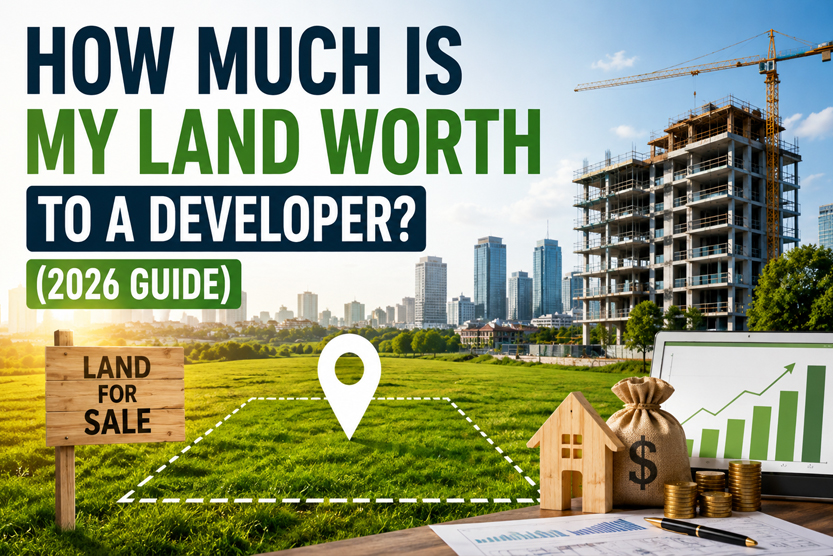
A developer calls, says they’re interested in your property, and suddenly you’re asking the same question every landowner asks at this point: how much is my land worth to a developer? Not what a home buyer would pay. Not what the county assessor has it listed at. What a developer, specifically, would pay.
The answer isn’t a fixed number pulled from a comps sheet. Developers value land by working backward from a finished project – condos, apartments, retail, whatever the zoning allows – and figuring out what’s left over after they pay for construction and take their cut. Once you understand that math, you stop guessing and start negotiating like someone who knows what the offer is actually built on.
Why Developer Value Isn’t the Same as Market Value
Here’s the thing most landowners get wrong at first: a developer isn’t comparing your parcel to the house down the street. They’re comparing it to a building that doesn’t exist yet.
A regular buyer looks at similar homes nearby and offers something close to that number. A developer skips that step entirely and works backward from what the finished project could sell for. That’s exactly why how much your land is worth to a developer can end up wildly different from its listed market value – sometimes a lot higher, sometimes lower. Two parcels a mile apart, similar size, similar price on paper, can pull completely different offers once zoning and buildable area come into the picture.
How Developers Actually Calculate a Price
Most developers lean on something called residual land value. It sounds like jargon, but it’s really just subtraction. Start with what the finished building will sell for. Subtract what it costs to build. What’s left is what they can afford to pay you.
Roughly, it breaks down like this:
- Finished project value: What will the completed homes, condos, or commercial space sell or lease for once built?
- Hard costs: Materials, labor, site work, grading. The stuff you can point at.
- Soft costs: Architects, engineers, permits, financing fees, legal bills. The stuff you can’t.
- Required profit margin: Usually 15–20%, because nobody takes on a multi-million-dollar construction project for free.
Whatever survives that subtraction is the number that lands on the table for your land. Not before.
What Actually Moves the Number Up or Down
Zoning, Above Everything Else
If there’s one factor that decides how much your land is worth to a developer more than any other, it’s zoning. A lot zoned for six units is worth dramatically more than the identical lot next door zoned for one house — same dirt, same square footage, completely different ceiling. Appraisers call this “highest and best use,” and it’s the lens almost every serious offer gets filtered through.
Where It Sits
Land near transit, schools, retail, and jobs pulls a higher price, full stop. Good road access and street frontage mean lower prep costs and a faster-selling finished product, and developers will pay more for both.
Size and Shape
Bigger, more regular parcels usually support more units than an odd-shaped lot with the same acreage on paper. A creek running through it, a steep slope, an easement cutting across the middle – all of that eats into buildable square footage, and developers price that loss straight into the offer.
What’s Already in the Ground
Land that already has water, sewer, and power running to it costs a fraction of what raw acreage costs to develop from scratch. Every dollar spent trenching in utilities is a dollar that doesn’t make it into your check.
What the Market Actually Wants
A developer chasing condos doesn’t care about general land prices – they care about condo demand in your zip code specifically. Short on rental housing but drowning in vacant retail? That gap decides who shows up with an offer and how big it is.
How Messy the Site Is
Environmental reports, soil tests, demolition, a rough entitlement process with the local planning board — all of it eats into the cost side of a developer’s spreadsheet. A clean, ready-to-build parcel earns a stronger offer than one that needs a fight to get approved.
Figuring Out What Your Land Is Actually Worth
Get a real appraisal. Not a drive-by estimate – a licensed appraiser who specializes in development land and knows how to run a residual land value analysis. The Appraisal Institute keeps a directory if you need somewhere to start.
Talk to more than one developer. One might see a 20-unit building on your parcel. Another only sees room for four lots. You won’t know the real range until you get more than one number on paper.
Bring in an agent who actually works in development land. Not your cousin’s friend who sells starter homes. Someone who tracks local zoning changes and knows which developers are buying right now.
Check what land near you has actually sold for. Recent average land prices per acre in your area give you a baseline before anyone sits down across the table from you.
Negotiating Like the Numbers Are Yours Too
Developers work off a spreadsheet, so bring one of your own. Ask them directly what they’re planning to build and how many units or square feet they expect to get approved – their answer tells you almost everything about their math. Get anything verbal in writing before you take it seriously. Talk to a real estate attorney who’s handled land sales to developers before signing anything, not after. And if more than one developer has shown interest, let them know it. Competition moves offers faster than politeness ever will.
When It’s Actually Worth Selling
Selling makes the most sense when the development upside on your land beats whatever you’d do with it yourself. If you’re sitting on raw acreage with no real plans, and a developer’s offer reflects genuine rezoning or subdivision potential, that premium is hard to match on your own. If instead you’re the one planning to finance and build, it’s worth running the numbers on what a land loan actually costs before comparing it against a developer’s offer – sometimes doing it yourself pencils out better than selling.
Frequently Asked Questions
How do developers determine what to offer for land?
Most run the residual land value method: estimate what the finished project sells for, subtract construction and soft costs and their required profit margin, and offer whatever’s left for the land itself.
Is land worth more to a developer than its market value?
Sometimes, yes. If zoning allows a lot more density or a more valuable use than the land currently has, a developer’s number can beat standard market value by a wide margin. If the site needs expensive infrastructure or environmental cleanup, expect the opposite.
Should I get an appraisal before talking to a developer?
Yes. An independent appraisal from someone who understands development land gives you a real number to negotiate from, instead of trusting the developer’s math on faith.
Do I need a real estate attorney to sell land to a developer
Strongly recommended. These deals usually come loaded with contingencies tied to zoning approval, environmental review, or financing, and an attorney is who keeps you protected if any of that shifts mid-deal.
Bottom Line
How much your land is worth to a developer comes down to their math, not yours: finished value minus construction costs minus their profit margin equals what lands on the table. Zoning decides the ceiling. Location, buildable area, utilities, and market demand push the number around from there. Get an independent valuation, talk to more than one developer, and treat the first offer as a starting point – not the deal.
Run your numbers through a land loan calculator before you make an offer, so you know exactly what you’re committing to each month.