Table of Contents
ToggleResidual Land Value Calculator
Estimate what a developer could realistically pay for your land, based on the same math they use.
Estimated residual land value
$0
Total costs deducted
$0
Profit reserved
$0
Value per acre
$0
As % of finished value
0%
This is an educational estimate based on the residual land value method. Actual offers vary by lender, market, and site-specific factors. Not a substitute for a professional appraisal.
Residual Land Value Calculator
If a developer has shown interest in your land, you’ve probably wondered what number they’re actually working from. This residual land value calculator shows you. Plug in a few numbers – what the finished project would sell for, construction costs, and a target profit margin – and you’ll see the same math a developer runs before they ever make an offer.
What Is Residual Land Value?
Residual land value is the amount left over after a developer subtracts every cost of building a project, plus their required profit, from what that finished project will sell for. It’s the number that decides what they can actually afford to pay for your land, not what your land is worth in a vacuum.
Most homeowners think about land value the way a real estate agent does – comparable sales, price per acre, recent transactions nearby. Developers think about it completely differently. They start with the end result and work backward. A residual land value calculator lets you run that same backward math yourself, so you walk into a negotiation already speaking their language.
How the Formula Works
The residual land value calculator on this page runs a simple four-step formula:
Residual Land Value = Finished Project Value − Hard Costs − Soft Costs − Required Profit
- Finished project value is what the completed homes, condos, or commercial space will sell or lease for once built.
- Hard costs cover construction: materials, labor, site work, and grading.
- Soft costs cover everything that isn’t physical construction: architectural plans, permits, engineering, financing fees, and legal work.
- Required profit is the margin a developer needs to justify the risk. Most developers target somewhere between 15% and 20% of the finished project value.
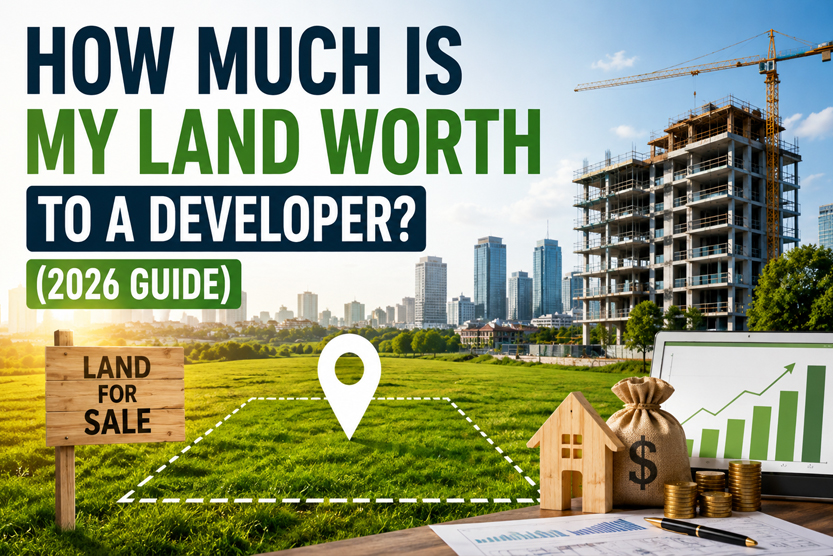
Whatever is left after all four deductions is the residual – and it’s the ceiling on what a rational developer will offer for your land. If you want a deeper walkthrough of how each of these pieces gets estimated in practice, our guide on how much your land is worth to a developer breaks down every factor that moves this number up or down.
How to Use This Residual Land Value Calculator
- Enter the finished project value. If you don’t know this number yet, check recent sale prices for similar new construction in your area, or ask a developer directly what they think the finished units would sell for.
- Enter hard and soft costs. A local contractor or developer can usually give you rough per-square-foot construction estimates. Soft costs typically run 10–15% of hard costs.
- Set the profit margin. Leave the default at 18% for a typical mid-range estimate, or adjust it based on what developers in your market are actually targeting.
- Add acreage, if you know it. This gives you an estimated value per acre alongside the total, useful for comparing against other land sales nearby.
- Click calculate. The tool shows your residual land value, the total costs deducted, the profit reserved, and – if you entered acreage – a per-acre estimate.
Why This Number Matters More Than Market Comps
A comparable sales approach tells you what similar raw land recently sold for. It says nothing about what a specific developer can afford to pay for your specific parcel, given what they’re planning to build on it. Two lots with identical market comps can produce very different residual land values once zoning, buildable area, and local construction costs enter the picture.
That’s why developers rarely negotiate off comparable sales alone. They negotiate off their own residual land value model, and if you don’t have a rough version of that same model, you’re negotiating blind. This calculator closes that gap.
Limitations to Keep in Mind
This residual land value calculator gives you a solid estimate, not a guaranteed number. A few things it doesn’t account for:
- Site-specific costs, like environmental remediation, demolition, or unusual grading requirements.
- Financing costs, which vary by lender, project size, and current interest rates.
- Market timing, since finished project values shift as demand and construction costs change.
- Entitlement risk, meaning the time and cost of getting a project approved through local zoning and planning.
For a number you can rely on in an actual negotiation, pair this estimate with a professional appraisal. The Appraisal Institute maintains a directory of certified appraisers who specialize in development land if you need a starting point.
Financing Your Own Land Purchase Instead
If you’re the one buying land rather than selling it to a developer, residual land value still matters — it tells you what a property might be worth to build on yourself, versus what you’d pay to acquire it outright. Once you know roughly what a parcel is worth, run the purchase numbers through our land loan calculator to see what your actual monthly payments would look like.
Frequently Asked Questions
What is a residual land value calculator used for?
It estimates what a developer can afford to pay for a piece of land, based on the finished project’s expected sale value minus construction costs, soft costs, and required profit margin.
Is residual land value the same as market value?
No. Market value comes from comparable sales. Residual land value comes from a specific development plan and can be higher or lower than market value depending on zoning, buildable area, and construction costs.
What profit margin should I use in the calculator?
Most developers target 15–20% of the finished project value. If you know what developers in your specific market typically require, use that number instead of the default.
Can I use this calculator if I’m buying land, not selling it?
Yes. The same formula works in reverse – it shows you what a parcel could be worth to develop, which helps you decide whether an asking price leaves room for a profitable project.
This residual land value calculator gives you the same starting math a developer uses before they ever make an offer. It won’t replace a professional appraisal or a real conversation with a developer, but it puts a number on the table before you sit down to negotiate -and that number is worth having.